When the Predictions Collapsed: Lessons from Recent Primary Chaos and What They Mean for Future Nomination Races

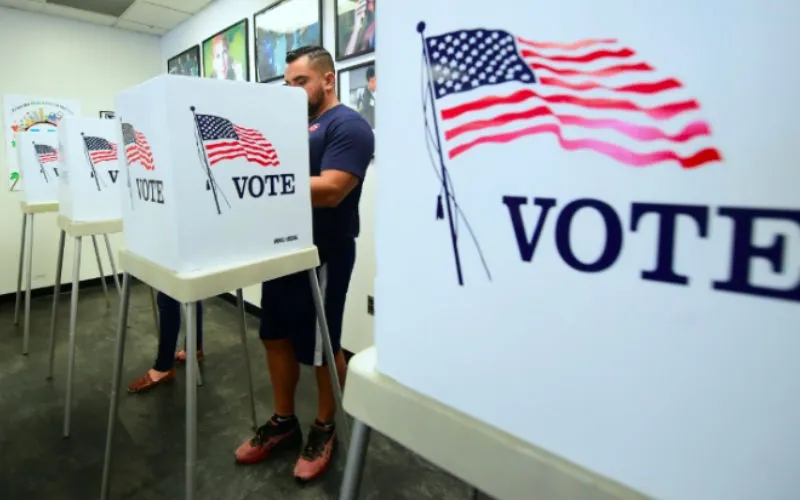
Photo: election primary voting booth ballot American democracy crowd, via img.freepik.com
Primary forecasting has never been a precise science. The compressed timelines, low-turnout dynamics, and outsized influence of motivated ideological minorities make nomination contests structurally different from general elections in ways that consistently defeat models built on general-election assumptions. But something more fundamental has shifted in recent cycles. The tools that political professionals relied upon to anticipate primary outcomes — traditional polling, endorsement tracking, fundraising totals, name recognition metrics — have performed with a consistency of failure that demands serious analysis.
For anyone invested in understanding how American democracy actually functions, the wreckage of recent primary predictions is an instructive place to start.
The Polling Problem Is Structural, Not Incidental
When primary polls miss badly, the instinct is to attribute the failure to methodological error — a bad sample, a poorly worded question, a late-breaking event that moved voters after the survey closed. Some of those explanations are valid in individual cases. But the pattern of misses across multiple states and multiple cycles points toward something more systemic.
Primary electorates are, by definition, the most difficult populations to model. Likely-voter screens that work reasonably well for November elections are notoriously unreliable when applied to primaries, where turnout is lower, less predictable, and more sensitive to local organizing intensity than to broad national trends. A candidate who generates exceptional enthusiasm among a narrow but highly motivated constituency can dramatically outperform their polling average simply because their supporters show up at a rate the models did not anticipate.
The rise of early voting and mail ballots has compounded this problem by extending the effective election period across weeks rather than a single day. A poll conducted ten days before election day may accurately capture voter sentiment at that moment while failing entirely to predict an outcome shaped by ballots cast before a late-breaking development altered the race.
Endorsements Lost Their Predictive Power
For decades, the "invisible primary" — the competition for endorsements from party officials, elected leaders, and institutional stakeholders — served as a reliable leading indicator of primary success. Political scientists documented the pattern extensively. Candidates who consolidated establishment support early tended to win nominations. The endorsement primary was treated as a proxy for coalition viability.
Recent cycles have disrupted that relationship in ways that strategists are still working to understand. High-profile endorsements have not merely failed to deliver expected vote margins; in some contests, they appear to have functioned as modest liabilities, signaling to certain voter segments that a candidate represented the political status quo at a moment when those voters were actively seeking disruption.
This does not mean endorsements are worthless. Institutional support still provides access to donor networks, volunteer infrastructure, and earned media. But the translation of that support into actual primary votes has become unreliable in ways that complicate the strategic calculus for campaigns and their advisors.
Demographic Assumptions That Did Not Hold
Perhaps the most significant source of forecasting error in recent primaries has been the failure of demographic models to predict how specific voter groups would behave. Assumptions about age cohorts, educational attainment, and racial and ethnic communities that had been treated as settled strategic knowledge turned out to be far more fluid than the models suggested.
In several competitive primaries, candidates who were projected to dominate with college-educated suburban voters underperformed significantly in those precincts while exceeding expectations in working-class communities that conventional wisdom had assigned to their opponents. Younger voters, frequently modeled as a reliably progressive constituency, split in unexpected directions in multiple contests. Latino voters in particular demonstrated a heterogeneity of political preference that continued to confound campaigns operating from aggregated demographic assumptions rather than granular community-level analysis.
The lesson here is not that demographics are irrelevant to primary forecasting. It is that demographic categories are containers, not predictors. The political meaning of belonging to any given demographic group is itself contested and evolving, and models that treat those categories as stable behavioral units will continue to generate errors.
What Structural Changes in Early States Are Doing to Candidate Viability
The Democratic Party's decision to restructure its early primary calendar — elevating South Carolina and introducing Nevada, New Hampshire, and Michigan as early contests — represents one of the most significant formal changes to the nomination process in decades. The full strategic implications of that restructuring are still unfolding, but the directional effect is clear: the ideological and demographic composition of the early electorate has shifted in ways that advantage different candidate profiles than the old Iowa-New Hampshire sequence did.
For candidates plotting a path to a 2028 nomination, understanding the specific electorate of each early state is now a more complex undertaking than it was in previous cycles. A campaign strategy built on the assumption that strong performance in predominantly white, rural Iowa caucuses would generate the media momentum necessary to compete nationally is simply no longer applicable. The new early states reward different organizational investments, different retail politics approaches, and different coalition-building strategies.
Reading the Arena Ahead of 2028
What should strategists, analysts, and engaged citizens take from this record of forecasting failure? Several conclusions seem defensible.
First, humility about predictive models is not a sign of analytical weakness — it is a prerequisite for accurate analysis. The primaries of recent cycles have demonstrated that overconfidence in conventional political wisdom is itself a strategic liability.
Second, the structural changes reshaping primary electorates are ongoing, not resolved. Demographic shifts, changes to party rules, the continued evolution of media consumption patterns, and the unpredictable dynamics of candidate emergence will continue to generate surprises.
Third, and perhaps most importantly, the primaries are where the actual competition of political ideas is most concentrated and most consequential. General elections often ratify choices made months earlier in low-turnout contests that most citizens ignore. Paying attention to the primary arena — understanding its rules, its electorates, and its incentive structures — is not an activity reserved for political professionals. It is a form of civic engagement that any serious participant in democratic life should consider essential.
The predictions will keep collapsing. The question is whether we learn the right lessons from the rubble.