Five Moments That Broke the Debate Stage: A Short History of American Persuasion on Live Television
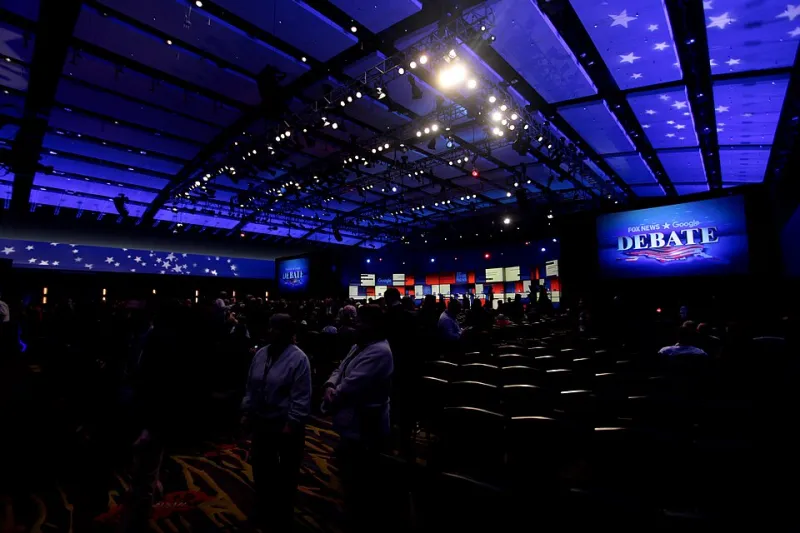
Photo: Gage Skidmore from Peoria, AZ, United States of America, CC BY-SA 2.0, via Wikimedia Commons
Every generation of American voters believes its debates are uniquely ugly. The historical record suggests otherwise — and also suggests that the real story isn't the ugliness. It's how the underlying purpose of the debate has quietly inverted. Once a machine for persuading the undecided, the televised debate has become a machine for manufacturing content for the already-decided.
Five moments tell the story.
1. The Sweat of 1960: Image Becomes Argument
When radio listeners scored the first Kennedy–Nixon debate a draw, while television viewers saw a decisive Kennedy win, American politics discovered that the medium was no longer carrying the message — it was the message. Nixon's pallor and visible discomfort under the studio lights did more damage than any answer he gave.
The lesson campaigns took away was not "be healthy." It was "the performance is the product." Every debate preparation since has been, at bottom, an exercise in stagecraft management.
2. "There You Go Again": The Birth of the Rehearsed Jab
Ronald Reagan's 1980 dismissal of Jimmy Carter's arguments was, by any technical measure, a deflection. It was also devastatingly effective — a pre-loaded phrase, tested in rehearsals, timed for maximum release. Carter, a substantively prepared debater, had no answer for a line that wasn't an argument at all but a piece of theater.
This is the moment the debate prep industry truly professionalized. The goal shifted from having the best command of the issues to having the best zinger in the holster. Persuasion gave way to the clip.
3. "Senator, You're No Jack Kennedy": The Zinger Era Peaks
Lloyd Bentsen's 1988 rebuke of Dan Quayle demonstrated the full maturity of the form: a devastating line that had nothing to do with the question, delivered with rehearsed stillness. It won the exchange, dominated the next day's coverage — and changed precisely nothing about the election's trajectory.
That is the paradox worth sitting with. The most famous debate moment of the era moved no voters. It entertained the base and filled the highlight reel. The debate had become, functionally, a content generator.
4. The Town Hall of 1992: A Brief Golden Hour
Then came the 1992 Richmond town hall debate — Clinton, Bush, and Perot answering undecided voters directly, wandering toward the questioners, checking watches and connecting. For one evening, the format briefly reclaimed its original purpose: not candidate versus candidate, but candidates facing actual citizens with actual questions.
It remains, three decades later, the high-water mark of the genre — and notably, it has rarely been replicated with the same openness since. Formats that empower real questions are formats campaigns cannot fully control.
5. The Modern Muted Stage: Argument as Ammunition
Which brings us to the present, where the defining features of recent debate cycles — crosstalk, fact-check wars, post-debate clip wars fought on social platforms within minutes — reflect a format optimized for no one in the room. The debate is no longer primarily for the audience in the hall or even on television. It is raw material for the after-market: the supercuts, the reaction videos, the fundraising emails drafted before the closing statements end.
The candidates know it. Their prep sessions now include practicing facial expressions for the split screen, because the split screen is where the clip economy lives.
What a Serious Debate Would Look Like
Here is the opinion portion of this piece, offered plainly: the problem is not that debates are theater. Some theater is fine. The problem is that we've built a theater with no plot.
A genuinely useful modern debate would borrow from the streaming era rather than fight it. Imagine longer formats — ninety uninterrupted minutes on a single policy domain, rather than ninety seconds across ten topics. Imagine follow-ups that are mandatory: a moderator empowered to say "you didn't answer; you have thirty more seconds." Imagine segments where each candidate must restate their opponent's strongest argument to the opponent's satisfaction before rebutting it — a debate club technique as old as the form, and one that makes evasion visibly evasive.
Would such a format produce better television? Probably not. It would produce something better than television: information. Voters would learn not who lands the punch, but who can hold a position under sustained pressure, who concedes what is true, and who can articulate the other side well enough to be trusted attacking it.
The great debate moments of the last sixty years trace an arc from image, to zinger, to clip, to chaos. Reversing that arc doesn't require nostalgia for black-and-white consoles. It requires only that we decide, as viewers and voters, what we actually want the stage to be for.


