The Endorsement as a Weapon: How Party Insiders Use Approval — and Its Absence — to Police Their Own
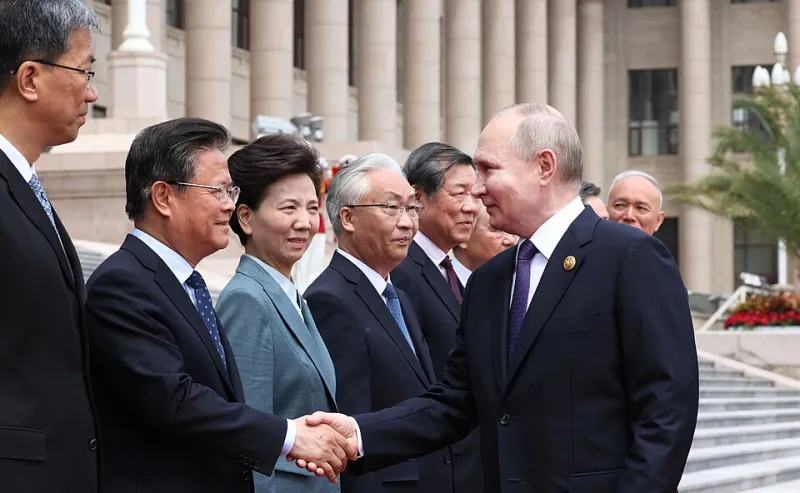
Photo: Официальный веб-сайт Президента Российской Федерации, CC BY 4.0, via Wikimedia Commons
An endorsement, on its surface, appears to be the most benign instrument in democratic politics. One elected official vouches for another. Voters receive a signal. The process moves forward. Yet the architecture concealed beneath that simple transaction is considerably more intricate — and, for those on the receiving end of its punitive applications, considerably more damaging — than the civics-textbook version suggests.
Across both major parties, leadership figures have refined the art of deploying endorsements not merely as expressions of genuine support, but as disciplinary tools. The goal is rarely stated plainly. It does not need to be. When a sitting senator declines to endorse a colleague who has deviated from the caucus position on a high-stakes vote, the silence communicates everything a public statement would — without generating the kind of headlines that invite scrutiny.
The Architecture of Informal Pressure
Understanding how this mechanism operates requires distinguishing between two separate but related phenomena: the weaponized endorsement and the weaponized non-endorsement.
The former involves party leadership actively throwing its institutional weight behind a primary challenger to punish a sitting member who has stepped out of line. The latter — subtler but arguably more pervasive — involves the coordinated withdrawal of support, donor access, and organizational infrastructure from any candidate deemed insufficiently loyal to the established order.
Both strategies exploit a structural reality of American primary elections: in low-turnout contests dominated by highly engaged, ideologically motivated voters, an institutional endorsement carries disproportionate weight. It activates donor networks, generates earned media, and signals to local party operatives where their organizational energy should flow. A candidate denied that infrastructure does not simply lose a symbolic blessing. They are often denied the very machinery required to run a credible campaign.
Case Studies in Controlled Competition
The 2022 midterm cycle produced several instructive examples. In states where redistricting had scrambled district lines and opened new competitive seats, party committees in both Pennsylvania and Georgia made deliberate decisions about which primary candidates would receive coordinated expenditure support — and which would be left to raise money independently, often against well-funded opponents with committee backing.
In multiple instances, the candidates denied support were not ideological outliers by any traditional measure. Their offense, according to party operatives speaking on background, was procedural rather than philosophical: they had declined to clear the race when asked, had publicly questioned leadership priorities, or had maintained relationships with advocacy organizations the party establishment viewed as disruptive.
The message delivered through these decisions was not lost on other members watching from their own districts. Several representatives, when asked by constituents why they had reversed positions on specific legislative amendments, offered explanations that were conspicuously vague — a pattern that correlates, in multiple documented cases, with upcoming endorsement decisions by senior figures in their state delegations.
When the Threat Is the Point
Perhaps the most consequential dimension of endorsement politics is not what happens when the mechanism is deployed, but what happens in the long anticipation of its potential deployment. Political scientists who study legislative behavior have documented what is sometimes called the "shadow primary" effect: the tendency of elected officials to calibrate their votes and public statements not merely to their current constituents, but to the imagined preferences of a future primary electorate they may face if leadership decides to recruit a challenger against them.
In this environment, the endorsement threat functions less as a weapon and more as a permanent background condition — a gravitational force that shapes legislative behavior without ever needing to be explicitly invoked. A member considering a bipartisan amendment on an infrastructure package does not need to receive a phone call from the whip's office. The structural incentives are sufficiently clear that the calculation is performed internally, often unconsciously.
This dynamic raises a question that sits at the center of any serious discussion about representative democracy: if an elected official's vote is shaped primarily by the anticipated response of party gatekeepers rather than by constituent interests or genuine policy judgment, in what meaningful sense is that official representing anyone?
The Counter-Argument and Its Limits
Defenders of robust party endorsement systems offer a legitimate counter-position. Political parties, they argue, exist precisely to aggregate preferences and coordinate action among legislators who share broad ideological commitments. An endorsement process that rewards loyalty and coherence is not a corruption of democracy — it is an expression of how organized political competition is supposed to function. Voters who elect candidates under a party banner are, on this view, implicitly endorsing the collective commitments of that organization, not merely the individual in question.
This argument has genuine force. A legislature populated entirely by independent agents, each pursuing idiosyncratic policy visions, would struggle to build the coalitions necessary to pass meaningful legislation. Some degree of coordination — and some mechanism for enforcing it — is inherent to functional party governance.
The difficulty arises when the enforcement mechanism becomes so powerful, so precisely calibrated, and so strategically deployed that it eliminates the very intra-party debate that distinguishes a functioning democratic coalition from a hierarchical command structure. There is a meaningful difference between a party that endorses candidates who broadly share its values and a party that systematically destroys the electoral prospects of any member who deviates from a specific leadership agenda on a specific vote.
The Transparency Deficit
What makes this dynamic particularly resistant to public accountability is its opacity. Endorsement decisions are rarely explained in granular terms. Donor redirection happens through private conversations. Organizational support evaporates without formal announcement. The candidate left standing in a primary without party infrastructure may know precisely why their calls to the state committee went unreturned — but documenting that causal chain for voters or journalists is extraordinarily difficult.
This is where the debate forum model that drives platforms like PolitArena becomes not merely useful but genuinely important. When voters have access to structured discussions about the specific mechanisms through which political power is exercised — and when those discussions are grounded in documented case studies rather than partisan assertion — the informal accountability gap narrows. Sunlight, applied with precision, remains the most effective disinfectant available to a democratic public.
What Competitive Democracy Actually Requires
The standard for evaluating any endorsement system should not be whether it produces loyalty — parties will always seek that — but whether it permits legitimate competition among ideas and candidates to occur in the first place. A primary process in which the outcome is effectively predetermined by institutional gatekeeping before a single vote is cast is not a competitive election. It is a ratification ceremony.
Elected officials who genuinely represent their constituents — rather than their caucus leadership — require some degree of insulation from the most coercive applications of endorsement politics. Building that insulation requires informed voters, transparent party processes, and a press willing to trace the specific decisions that determine which candidates receive institutional oxygen and which are quietly suffocated before they reach the starting line.
The endorsement, in the end, is not inherently a weapon. But in the hands of leadership that prioritizes conformity over competition, it becomes one — and democracy, as always, pays the price.