The Empty Chairs of Campaign Season: How Politicians Learned to Fear the Unscripted Room
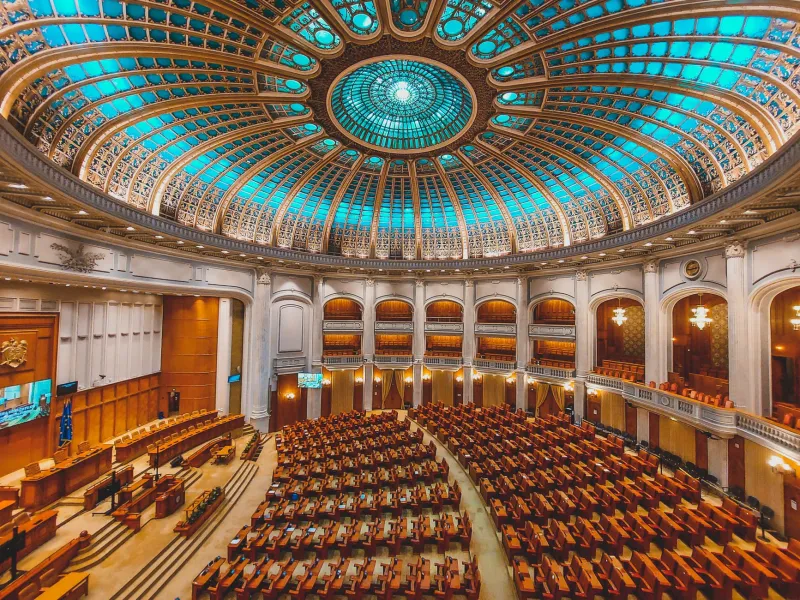
Photo: Michal Klajban, CC BY-SA 4.0, via Wikimedia Commons
There is a particular sound in American politics that is becoming harder to find: a constituent standing up in a school gymnasium, holding a microphone, asking an elected official a question nobody on the candidate's staff has previewed.
It used to be the soundtrack of every campaign. Today, it's close to an endangered species — and the reasons why say more about the modern political economy than any poll or focus group ever could.
The Risk Ledger Behind the Missing Gymnasium
Start with the arithmetic that every campaign now runs, often without anyone admitting it out loud. A traditional town hall offers a candidate maybe ninety minutes of uncertain exposure in front of a few hundred people, with the possibility of a single awkward moment being clipped, captioned, and viewed eight million times by Tuesday.
A friendly podcast interview offers an hour of conversation with a host who shares the candidate's general orientation, distributed to an audience that is already sympathetic. A scripted livestream offers total message control. A closed-door fundraiser offers money without a single question from anyone who didn't pay to be in the room.
When you lay those options side by side, the retreat from the open town hall stops looking like cowardice and starts looking like a rational — if corrosive — response to incentives. The viral clip economy has made the cost of a bad moment essentially infinite, while the reward for a great unscripted exchange is modest. A candidate can win a town hall and gain a local news paragraph. A candidate can lose one and lose a week of the news cycle.
The result is what one veteran campaign operative described as a slow evacuation: "Nobody decides to stop doing town halls. They just quietly never schedule one, and two cycles later, nobody expects them to."
The Audience That Shows Up Isn't Neutral
There's a second factor that gets less attention: the composition of the room itself. Town halls in the modern era are rarely filled with persuadable swing voters. They attract the activated — the organized, the angry, and the deeply committed from both directions. Primary challengers and opposition researchers know that a town hall is the single most efficient venue for manufacturing a confrontation that will be filmed from six angles.
For a member of Congress representing a safely drawn district, the calculus is even simpler. The people most likely to show up and challenge them are often from the opposing party — voters they cannot win in any case — while the voters they do need are reachable through targeted digital advertising that never risks an unscripted moment. The gymnasium, once a tool of persuasion, has been repurposed as a stage for ambush. So the stage goes dark.
What We Lose When the Room Empties
Defenders of the retreat make a fair point: a screaming town hall is not a deliberative forum, and no one's mind was ever changed by a constituent shouting over a moderator. Fair enough. But the loss is real, and it operates on three levels.
First, the public loses the visible experience of accountability. Watching an official think on their feet — stumble, recover, concede a point, get flustered — is a form of information no cut video can replicate. Scripted formats hide exactly the qualities voters most need to evaluate: composure, honesty under pressure, the willingness to say "I don't know."
Second, the politician loses contact with reality. Campaigns are echo chambers by design. The town hall, for all its chaos, is one of the few remaining environments where a candidate hears an unfiltered objection in real time. Advisors can't spin a heckler. A poll can't reframe a retired teacher asking about her pension.
Third, and most corrosively, the norm erodes. Every cycle in which open questioning becomes rarer makes its absence more acceptable. What begins as prudence hardens into expectation, and eventually into precedent.
The Holdouts
And yet they persist. In Iowa and New Hampshire, the retail tradition still exerts a strange gravitational pull — the first-in-the-nation states have never fully surrendered the living room and the diner booth, and their presidential-era town halls remain the closest thing American politics has to a stress test. Some members of Congress, in both parties, continue to schedule open forums in their districts every recess, accepting the occasional viral humiliation as the price of the practice.
These holdouts are not uniformly virtuous, and showing up to a town hall is not a substitute for a record. But notice what their persistence demonstrates: the format still works on the voters who attend. Constituents who leave a town hall disagreeing with the politician frequently report a grudging respect for the fact that the politician came. In an era of maximum message control, mere presence has become a differentiator.
Changing the Game, Not Blaming the Players
If PolitArena stands for anything, it is the conviction that democracy improves when ideas are forced to compete in the open. The lesson of the town hall's decline is not that politicians have uniquely deteriorated. It is that we built an information environment in which the open exchange of ideas is the highest-risk strategy available — and then acted surprised when everyone stopped choosing it.
The fix is structural, not moral. Local news outlets can commit to covering substantive town halls rather than only their worst moments. Civic organizations can host formats with rules — timed responses, submitted-and-live question mixes, moderated follow-ups — that reward substance over spectacle. And voters can send the only signal campaigns reliably read: rewarding the candidates who show up, and noticing, audibly, the ones who don't.
The empty chairs of campaign season are not an accident. They are a choice — ours to unmake.